
Formulatrix Automated Liquid Handling
Formulatrix automated liquid handling portfolio includes the liquid dispensers Mantis® and Tempest® alongside the liquid handlers F.A.S.T.™ and FLO i8® PD. Our systems streamline workflows and exhibit adaptability across a multitude of applications.

Mantis - Precise Liquid Dispenser
The Mantis is a programmable, low dead volume, non-contact liquid dispenser that can reliably dispense a variety of solutions including those containing beads, cells, proteins, enzymes, probes, and master mixes.
- Miniaturize reactions, scale up throughput, save on reagents, and remove pipette tip cost
- Dispense volumes down to 100 nL at CV < 2%
- Verify every dispense run with the Quality Control Droplet Detection Station
- Define labware in seconds with the new Interactive Labware Teaching module
Tempest - Bulk Liquid Dispenser
The Tempest is a non-contact, bulk reagent dispenser that utilizes 96 individually controlled nozzles to dispense any volume of up to 12 different reagents into any well.
- Ensure high accuracy and precision across a broad range of reagents, including cells and beads, using the non-contact microdiaphragm technology
- Deliver up to 12 reagents through 96 individually controlled nozzles
- Minimize reagent loss with non-recoverable dead volume as low as 48 μL per chip
- Rapidly dispense down to 200 nL (CV <5%) with no upper limit


F.A.S.T. - Liquid Handler
The F.A.S.T. (Flow Axial Seal Tip) is a reliable and easy-to-use liquid handler designed to move any viscosity of liquid quickly with its one-of-a-kind 96-channel head based on positive displacement technology.
- Save time on liquid transfers with a unique 96-tip head
- Save on consumables by using your choice of 1, 8, 12, or 96 tips to transfer reagents between 96- and 384-well plates
- Perform cherry-picking, serial dilutions, and plate copies (broadcast, mother-daughter transfers) with ease
- Forget having to program liquid classes ever again; the positive displacement tips mitigate the effects of viscosity on accuracy
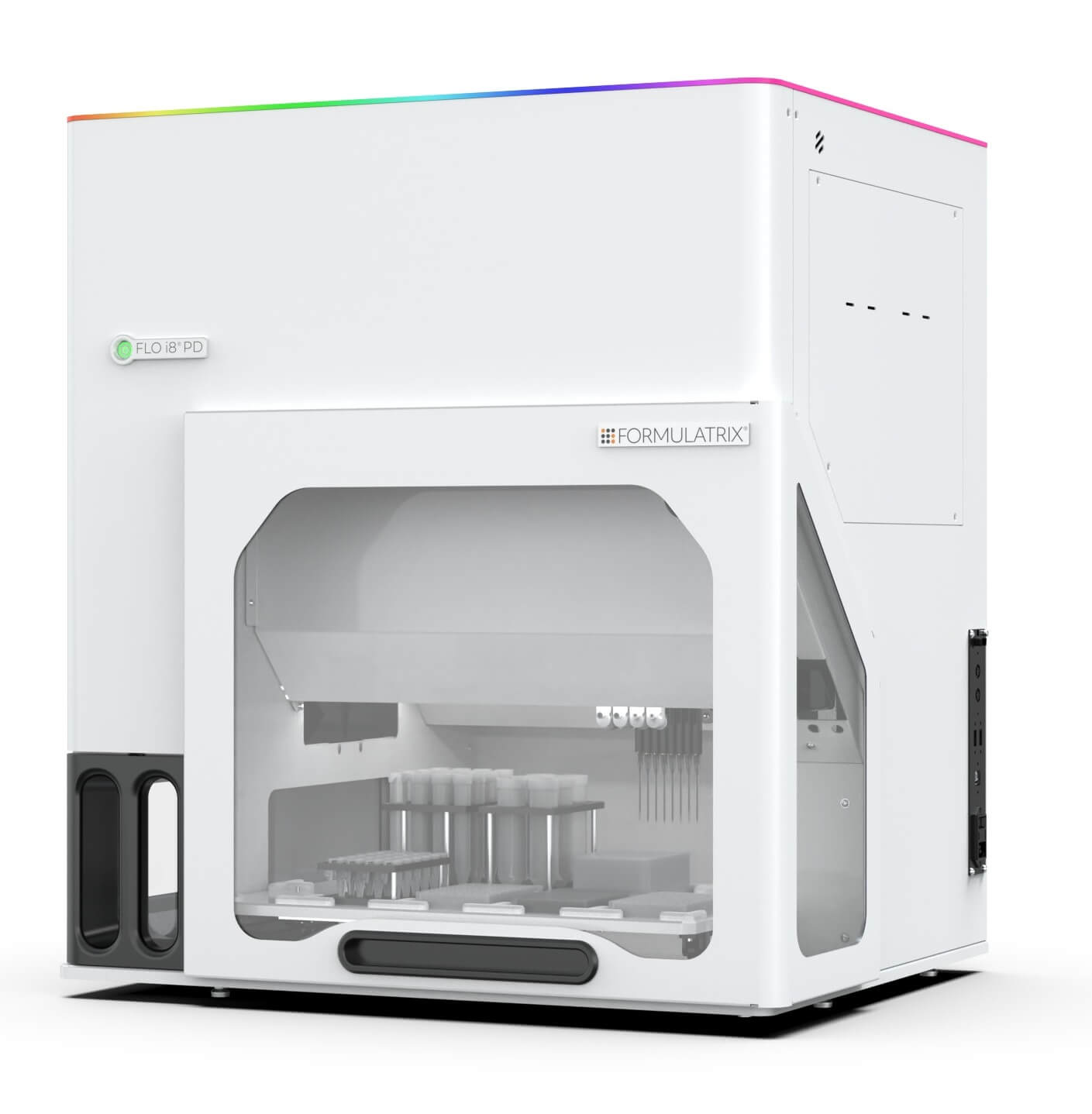
FLO i8 PD - Liquid Handler
The FLO i8 PD is ideal for optimizing your protocols and bench work, allowing you to focus on research, science, innovations, and breakthroughs.
- Easily design protocols with a user-friendly software
- Simplify tube or plate-based lab work using the variable spanning channels and pipetting range of 0.5 to 1000 μL
- Reduce variability in workflows and increase traceability and confidence in your experiments
- Automatically sense labware, detect and track liquid levels, and optimize liquid transfers in real time with no prior input of liquid properties
Common Applications

Automate all your NGS workflows, even at low volumes, including library normalization, PCR cleanup, pooling, fragmentation, end repair ligation, adapter ligation, and indexing.

Transfer delicate cells, organoids, spheroids, and beads without harming the homogeneity of suspensions for high-throughput assays and single-cell workflows for genome, exome, transcriptome, and proteome analysis.

Automate PCR workflows at miniaturized volumes. Streamline ther pre-PCR steps of serial dilutions, transferring samples, master mix, and primers, as well as post-PCR cleanup with magnetic beads.

Sterile and contamination-free transfer of cells, enzymes, and viscous and volatile compounds for high-throughput assays using built-in serial dilutions and picklist features for compound management.

Nucleic Acid Workflows
Speed up your nucleic acid extraction, recombination, and synthesis while avoiding cross-contamination and ensuring precision for high throughput screens.

Proteomics
Automate critical steps of proteomics workflows in proximity extension assays—such as Olink—allowing researchers to streamline processes, improve reproducibility, and accelerate discoveries.
Publications
FAQs
What is the Formulatrix’s Liquid Handling business unit focused on?
Formulatrix’s Liquid Handling unit is primarily focused on providing accessible, high-precision automation that eliminates the common pain points of traditional air-displacement systems. Based on two primary technologies (Microdiaphragm Pump and Positive Displacement), liquid handling unit allows for handling of versatile reagents from nL to mL range with exceptional precision. Our instruments have been designed to ensure precision, reproducibility, integration and accessibility for a wide range of workflows.
How does automated liquid handling improve results over manual pipetting?
Automation eliminates user-to-user variability, improves precision (especially at nanoliter scale), speeds up and scales workflows, and supports assay miniaturization. Together, these benefits lead to higher repeatability and efficiency, especially in complex or high-throughput protocols.