High-Throughput Sequencing and PCR: A Powerful Combination for Genomic Discovery
High-throughput sequencing and polymerase chain reaction (PCR) are two of the most important tools in modern biology. High-throughput sequencing allows scientists to read the DNA sequence of a gene or organism, while PCR allows them to amplify specific DNA sequences.
PCR and HTS technologies are constantly evolving, and new applications for these technologies are being discovered all the time. These technologies are essential tools for modern biology, and they will continue to play a vital role in our understanding of the world around us.

Sequencing Technologies and its types:
Sequencing is a process of determining the order of nucleotides in a DNA or RNA molecule. Sequencing can be used to identify genes, mutations, and other genetic variations.
There are two main types of sequencing technologies: Sanger sequencing vs Next Generation Sequencing (NGS).
- Sanger sequencing is a method that uses a chain-terminating dideoxynucleotide to determine the sequence of DNA. Sanger sequencing is a relatively slow and expensive method, but it is still widely used for research purposes.
- NGS is a method that uses a variety of different technologies to sequence DNA or RNA much faster and cheaper than Sanger sequencing. NGS is becoming increasingly popular for research and clinical applications.
RNA sequencing (RNA-Seq) is a type of NGS that is used to sequence RNA. RNA-Seq can be used to study gene expression, identify novel transcripts, and detect mutations in RNA.
RNA-Seq is a powerful tool that can be used to study the transcriptome, which is the complete set of RNA transcripts in a cell or organism. The transcriptome can be used to understand how genes are expressed in different tissues and under different conditions. RNA-Seq can also be used to identify novel transcripts, which are genes that have not been previously identified.
Polymerase chain reaction (PCR) and it types:

Polymerase chain reaction (PCR) is a technique used to amplify (make many copies of) a specific segment of DNA. PCR is used in a wide variety of applications, including medical diagnostics, forensic science, and genetic research.
Quantitative PCR (qPCR) is a variation of PCR that allows for the quantification of the target DNA sequence. qPCR uses a fluorescent dye that is bound to the primers. As the PCR reaction progresses, the amount of fluorescence increases, which is proportional to the amount of target DNA.
Reverse transcription PCR (RT-PCR) is a variation of PCR that allows for the amplification of RNA. RT-PCR is used to study gene expression, as it allows for the quantification of the amount of mRNA present in a sample. RT-PCR works by first converting the RNA into DNA using reverse transcriptase. The DNA is then amplified using PCR.
How High-Throughput Sequencing and PCR Work Together
Polymerase chain reaction (PCR) and High-throughput sequencing (HTS) are often used together in a process called library preparation. This process involves isolating and amplifying the DNA of interest from a sample. The amplified DNA is then fragmented in a process called dna fragmentation and attached to adapters, which are short sequences of DNA that help the fragments bind to the sequencing machine.
Once the library is prepared, it is sequenced using an HTS machine. HTS machines use different methods to sequence DNA, but they all work by detecting the nucleotides (A, T, C, and G) that make up the DNA molecule.

Applications of High-throughput sequencing (HTS) and polymerase chain reaction (PCR)

Diagnosis of
Infectious Diseases
Sequencing and PCR can be used to identify the specific pathogen causing an infection, which can help guide treatment

Cancer Detection and
Treatment
Aid in detecting cancer cells, identify the specific mutations and monitor the effectiveness of cancer treatment

Personalized
Medicine
Identify genetic variations that may affect a person's response to drugs or other treatments, help personalize treatment plans

Evolutionary
Biology
Help study the evolution of genes and organisms to understand how populations change over time and the genetic basis of diseases

Education and
Outreach
Help teaching students about biology and genetics to develop critical thinking skills in science and medicine

Environmental
Monitoring
Aid monitor the environment for pollutants, pathogens, and other harmful substances to protect public health and the environment

Drug
Discovery
Help in Identifying new drug targets, screen potential drug candidates, and assess the safety and efficacy of new drugs

Basic
Research
Widely used in basic research to study the structure and function of DNA and RNA for a deeper understanding of biology
PCR Technologies
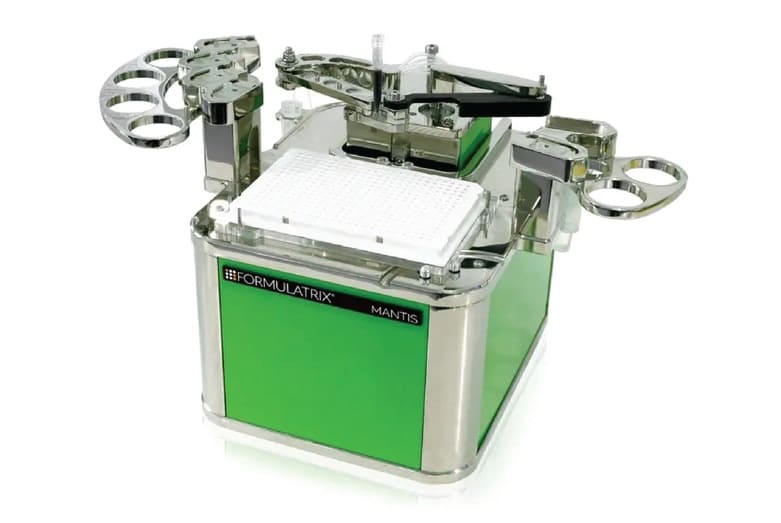
FORMULATRIX products are used in PCR applications to improve efficiency, reproducibility, and accuracy. The MANTIS Liquid Dispenser is a precise, tipless dispenser that can be used to dispense reagents into 96- and 384-well plates. This reduces dead volume, minimizes disposable pipette tips, and miniaturizes reaction volumes, saving on reagents. The MANTIS can also be used to perform high-throughput qPCR-based drug screens. In one study, the MANTIS was used to perform a high-throughput qPCR-based drug screen in stem cell-derived retinal cells. The results showed that the MANTIS® was able to acquire reliable data with homogeneity, precision, and faster dispensing. In addition to the MANTIS, the TEMPEST Bulk Liquid Dispenser is also an essential tool for any lab that wishes to perform the most efficient and reproducible genetic analysis.

Here are some additional benefits of using FORMULATRIX products in PCR applications:
- Increased throughput: The MANTIS can dispense reagents into plates up to 10 times faster than manual pipetting. This can significantly increase the throughput of PCR assays.
- Reduced costs: The MANTIS can reduce the cost of PCR assays by reducing the use of disposable pipette tips and reagents.
- Improved accuracy: The MANTIS is a precise and accurate dispenser that can help to improve the accuracy of PCR assays.
- Increased reproducibility: The MANTIS and TEMPEST can help to improve the reproducibility of PCR assays by reducing the variability introduced by manual pipetting.
NGS Technologies
FORMULATRIX products are also used in NGS and RNA Sequencing applications to improve efficiency, reproducibility, and accuracy. The MANTIS Liquid Dispenser can also be used to perform high-throughput NGS library preparation and sequencing.

Here are some specific examples of how FORMULATRIX products are used in NGS and RNA Sequencing applications:
- Miniaturized cDNA synthesis: The MANTIS can be used to dispense reagents for miniaturized cDNA synthesis reactions, which can be used to prepare RNASeq libraries for sequencing. This can save on reagents and time, and it can also improve the quality of the RNASeq data.
- Tagmentation: The MANTIS can be used to dispense reagents for tagmentation. Tagmentation helps to improve the accuracy and uniformity of the NGS reads.
- Indexing: The MANTIS can be used to dispense reagents for indexing that helps to distinguish between different samples, which is important for downstream analysis.
- Amplification: The MANTIS is used to dispense reagents for amplification that helps to increase the quantity of DNA or RNA in the library, which is important for sequencing.
- Nucleic acid cleanup: The MANTIS can be used to dispense reagents for nucleic acid cleanup. Nucleic acid cleanup removes contaminants from the library, which can improve the quality of the NGS data.
Application Notes and Webinars
An Assessment of the Volumetric Performance of the MANTIS® Liquid Handler Using the Artel MVS® Multichannel Verification System
Today, researchers generally regard automated workstations as the most reproducible liquid handling solutions, as automated liquid handling (ALH) systems remove many of the obstacles associated with user variability.

Streamlining Cell-based Workflows with Advanced Non-Contact Dispensing
Cell-based workflows play a vital role in the preclinical stages of drug discovery. These workflows involve dispensing cell suspensions or introducing other liquids into cell-containing plates.

Generating High-Quality cDNA Libraries for Efficient Sequencing of T-cell Receptor mRNA from Single Cells
Single-cell omics provide undiluted information about individual cells, such as transcription levels and sequences of highly variable proteins.

Making Liquid Handling and Lab Automation Accessible for All: The MANTIS, TEMPEST, FLO i8, and F.A.S.T.
We presented a solution spotlight talk at SLAS Europe about the company's mission to make lab automation more accessible for everyone.

Learn More About Our PCR & HTS Solutions